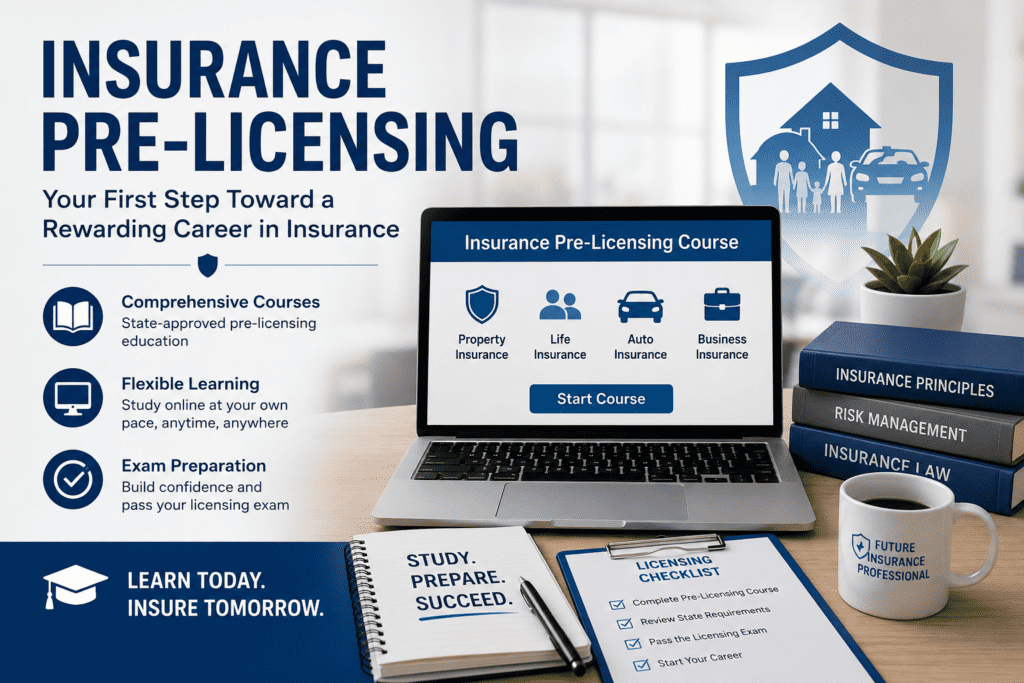
Success CE is pleased to announce that, effective June 1, 2026, our insurance pre-licensing courses are now available in all 50 states effective June 1, 2026
This nationwide expansion allows aspiring insurance professionals across the country to access the training and educational resources needed to prepare for their state licensing examinations and launch successful careers in the insurance industry.
We provide comprehensive, easy-to-understand instruction designed to help students build knowledge, confidence, and exam readiness.
For information regarding available courses, state-specific licensing requirements, and enrollment options, please visit our website or contact our team directly.
As the insurance industry continues to grow and evolve, the demand for knowledgeable and licensed professionals remains strong. Whether you are pursuing a career in life, health, property, casualty, or personal lines insurance, obtaining the proper license is an essential first step.
Our courses provide students with the knowledge, resources, and support needed to successfully navigate the licensing process. With flexible learning options, state-specific content, and a commitment to student success, Success CE is proud to help individuals across the nation achieve their professional goals and build rewarding careers in insurance.
Why Use Success CE
The Success Family of Continuing Education Companies provides the highest quality Life/Health and Property/Casualty Insurance Continuing Education. CFP Continuing Education, CIMA Continuing Education, CPA Continuing Education, CLU/ChFC (PACE) Continuing Education, and MCLE (Legal). Continuing Education available in all 50 states in Live Insurance, Online Insurance, and Textbook Insurance formats. Learn More
If you are holding an active insurance license in both Life & Health or Property Casualty, you know that meeting CE requirements, on time and correctly, is a non-negotiable part of staying licensed and compliant. That is where Success CE stands out. Here is why many agents use Success CE to renew their Life and Health and Property Casualty licenses:
Nationwide Approval & Wide-Ranging Course Catalog
Success CE’s courses are approved in all 50 states, covering both Life & Health and Property Casualty CE requirements. (Success CE)
Our catalog is not limited to basic CE: we offer courses in ethics, annuities, long-term care, and more allowing you to fulfill specialized requirements specific to your license type or state. (Success CE).
For agents holding licenses in multiple lines (e.g., Life & Health and P&C), this breadth simplifies compliance: you do not need to piece together CE hours from different providers or juggle multiple platforms.
Efficiency – Fast, Easy, and Convenient
We at Success CE emphasizes user convenience: our CE courses are “easy-to-complete,” and they offer same-day real-time reporting of completed credits. (Success CE)
For busy agents who do not want to spend extra time traveling to in-person classes or coordinating schedules especially those balancing Life & Health and P&C CE hours this convenience can save significant time and stress. (Success CE)
Our system allows for both online/self-study CE and live classroom/webinar CE (through a sister service) depending on what your state license renewal requires or which format you prefer. (insurancecontinuingeducation.com)
Cost-Effective – Competitive Pricing and Value
Success CE has a “Guaranteed Lowest Price” for their CE courses. (Success CE)
Given the ability to cover multiple license lines, specialized topics, and potentially bundle CE with other designations or certifications (CFP, CLU/ChFC, etc.), using Success CE may offer good value compared with juggling separate providers for each license line. (Success CE)
Good Reputation & Customer Experience
Customer testimonials highlighted on our site praise the ease of navigation, helpful customer service, and a simple CE process. (Success CE)
Additionally, agents report being able to complete CE quickly and renew licenses without the delays or hassles sometimes associated with other CE providers. (Success CE)
If you have ever had CE renewal frustration (especially juggling multiple license types), working with a provider that emphasizes reliability and service can make a meaningful difference.
Useful for Multi-Line License Holders – One Stop for Everything
Agents licensed in both Life & Health and P&C benefit from a single CE source that supports both license types, simplifying their compliance process.
Because Success CE offers a broad set of CE courses (ethics, annuities, long-term care, etc.), you can meet specialized continuing education requirements (e.g., annuity suitability, ethics) along with general CE hours all in one place. (Success CE)
Therefore, our unified approach reduces administrative overhead and helps ensure you do not miss any required credits for either license type.
Who Benefits Most from Success CE
Agents with multiple licenses (Life & Health and Property & Casualty ) who want to streamline their CE compliance.
Busy professionals who prefer online/self-study CE or flexible scheduling instead of in-person classes.
Agents looking for good value. We offer courses beyond “just the basics,” such as ethics, annuities, or long-term care.
Agencies or firms managing multiple producers Success CE offers services for individual licensees and corporate/agency-level CE administration. (Success CE)
Final Thoughts
For licensed agents juggling multiple license lines; Life & Health Property & Casualty, compliance shouldn’t feel like a chore. Success CE offers one of the most comprehensive, flexible, and cost-effective solutions available today. Their nationwide approvals, broad course catalog, easy-to-use online system, and strong reputation for customer service make them an appealing choice if you want to simplify CE compliance and focus more on serving clients.
Why Use Success CE
The Success Family of Continuing Education Companies provides the highest quality Life/Health and Property/Casualty Insurance Continuing Education. CFP Continuing Education, CIMA Continuing Education, CPA Continuing Education, CLU/ChFC (PACE) Continuing Education, and MCLE (Legal). Continuing Education available in all 50 states in Live Insurance, Online Insurance, and Textbook Insurance formats. Learn More
Preparing for a state insurance license or a securities registration exam is one of the most important steps in beginning a new career. Yet for many candidates, the experience can feel overwhelming: dense textbooks, outdated practice questions, and confusing explanations that don’t reflect today’s regulatory landscape.
Our mission is simple: Deliver the most complete, accurate, and user-friendly prelicensing study system available for insurance and securities candidates nationwide.
A Modern Approach to Prelicensing Education
While many providers rely on recycled outlines and decades-old content, PreLicensingTraining reimagined the entire learning process from the ground up. Every chapter, question bank, flashcard, and exam scenario has been built with deliberate intention — focusing on clarity, accuracy, and application.
Below are the core pillars that make our program different.
1. Content Written from the Perspective of Real Instructors
Our materials are not mass-produced or outsourced. They are crafted by experienced instructors who understand both the exam and the industry.
Instead of reading stiff technical paragraphs, students learn through:
Clear explanations
Practical examples
Real-life scenarios
Straightforward definitions
Logical sequencing of topics
This ensures students understand how insurance and securities concepts actually work, not just how to memorize them.
2. Exam-Aligned Structure and Design
Every state’s DOIs and FINRA functions are mapped exactly to the content we create. Our manuals:
Follow the official outlines line-by-line
Include the newest laws, time frames, regulations, and dollar amounts
Break down complicated rules into understandable, usable information
Prepare students for precisely what they will face on the exam
This alignment removes guesswork and increases passing confidence.
3. Professionally-Developed Flashcards
Unlike generic flashcards that simply repeat definitions, ours are designed as true learning tools, featuring:
One core concept per card
Concise questions with direct answers
Coverage of terminology, rules, laws, formulas, and exam-trigger concepts
A structure that reinforces memory retention
Students use them not just to memorize, but to understand.
4. Intelligent Question Banks
Our practice questions are not “randomly generated” or copied from outdated sources. They are written to mirror:
The style of state insurance exams
The structure of FINRA and NASAA tests
The complexity of actual licensing questions
Each question is followed by a clear explanation that teaches why the right answer is correct, and why the wrong answers are not. This builds real test-taking skill rather than encouraging guesswork.
5. Realistic Final Exams
Final exams simulate the look, feel, and pacing of the real test. They include:
Mixed difficulty levels
Scenario-based analysis
Regulatory application questions
Definitions and recall questions
Content-area weighting that matches the real exam
By the time students complete these practice exams, the actual licensing test feels familiar instead of intimidating.
6. Continuous Updating and Accuracy Controls
Regulatory updates happen constantly, both in the insurance industry and the securities world. Success PreLicensing.com maintains a rigorous update process to ensure that curriculum, questions, and examples reflect:
New laws
Revised statutes
Updated licensing requirements
Current regulatory expectations
Clarified exam outlines
Students can trust that what they are learning is relevant today.
Our students consistently report that our materials feel clearer, better organized, and more relevant than anything they’ve used before. They appreciate our:
Straightforward writing
Logical chapter design
Practical examples
Comprehensive coverage
Instructor-built questions
User-friendly structure
Realistic practice exams
Simply put: Our program is built to teach, not confuse.
A Better Way to Prepare for Licensing Exams
Whether your goal is to become an insurance agent, an investment professional, or a dual-licensed producer, Success PreLicensing.com provides a complete and modern preparation system that supports you from start to finish.
We are proud to be part of Success CE, and even more proud to help thousands of students take their first step into the industry with confidence.
Why Use Success CE
The Success Family of Continuing Education Companies provides the highest quality Life/Health and Property/Casualty Insurance Continuing Education. CFP Continuing Education, CIMA Continuing Education, CPA Continuing Education, CLU/ChFC (PACE) Continuing Education, and MCLE (Legal). Continuing Education available in all 50 states in Live Insurance, Online Insurance, and Textbook Insurance formats. Learn More
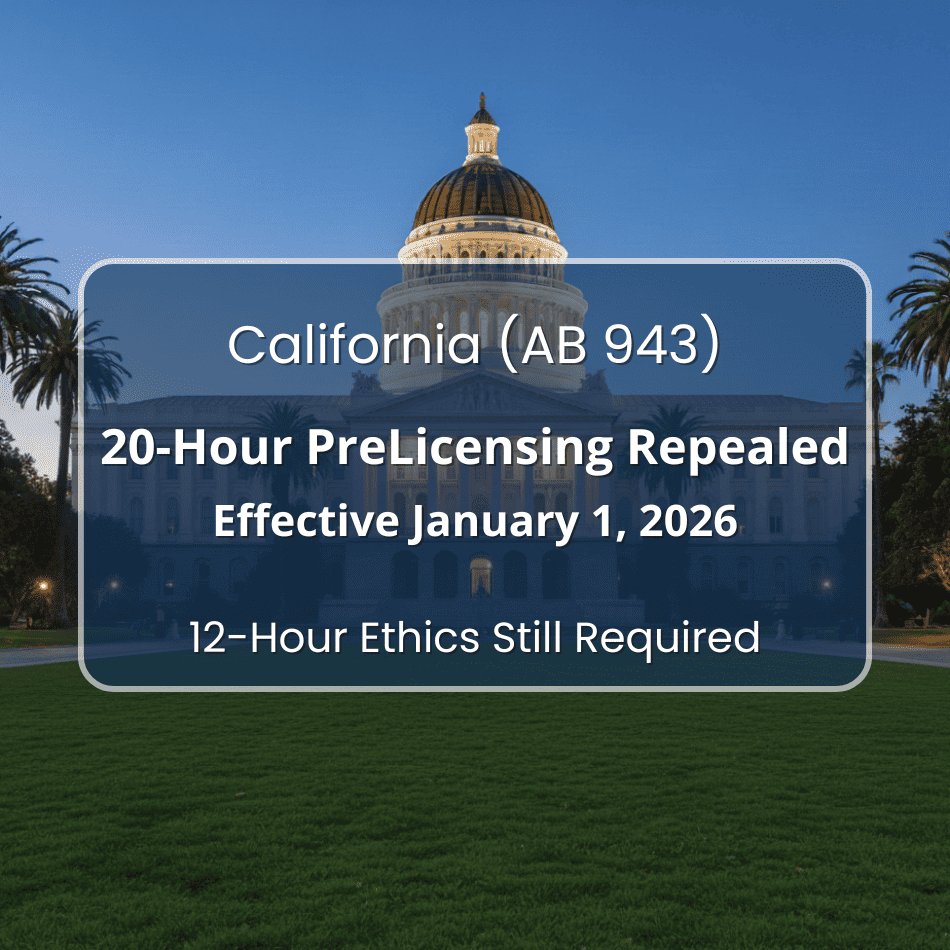
Effective January 1, 2026, CDI will officially eliminate the long-standing California 20-hour prelicensing education requirement for insurance producers.
This major regulatory update, established under AB 943 (Chapter 566, Statutes of 2025), reshapes the path to licensure for new agents across Life, Health, Property, Casualty, Personal Lines, Commercial Lines, and Limited Lines Automobile.
However, one part of the process does not change:
All applicants must still complete the mandatory 12-Hour Ethics & California Insurance Code course and pass the full state licensing exam.
This Ultimate Guide provides the most complete and authoritative breakdown of what is changing, what is staying the same, and how California insurance candidates and agencies should prepare for 2026 and beyond.
1. What AB 943 Means for California Insurance Licensing in 2026
Assembly Bill 943, signed into law on October 10, 2025, updates California Insurance Code §1749 and directly removes the 20-hour line-specific prelicensing education blocks for all major insurance producer licensing types.
Beginning January 1, 2026:
The 20-hour prelicensing requirement is fully repealed.
The 12-Hour Ethics & California Insurance Code requirement remains mandatory.
The state licensing exam continues for every line of authority.
Fingerprinting remains required after exam passage.
Existing 20-hour, 32-hour, and 52-hour courses will be removed from CDI’s public course search on January 1, 2026, and inactivated January 12, 2026.
2. Key Changes at a Glance (Quick Summary for 2026)
Requirement
Status in 2026
Notes
20-Hour Prelicensing
Repealed
Eliminated by AB 943
12-Hour Ethics & California Insurance Code
Required
Must be completed by all producer applicants
State Licensing Exam
Required
Unchanged requirement
Fingerprinting
Required
Must occur after passing the exam
Applies To
Life, A&H, Property, Casualty, Personal Lines, Commercial Lines, Limited Lines Auto
Not Affected
Bail agents; public adjusters
Their 20-hour requirement remains
These changes come directly from CDI’s November 2025 notice and AB 943 implementation guidance.
3. Why California Removed the 20-Hour Prelicensing Requirement
California modernized its licensing pathway to:
Remove barriers to entry for new producers
Streamline the licensing timeline
Prioritize competency through Ethics & Code and exam performance
Align with evolving national standards for producer onboarding
The Legislature determined that the 12-Hour Ethics requirement + the state exam serve as adequate competency benchmarks without the need for additional 20-hour blocks.
4. What the California 20-hour pre-licensing repeal changes on January 1, 2026
A. The California 20-Hour Prelicensing Courses Are No Longer Required
CDI will no longer recognize or display the following course types:
20-Hour line-specific courses
32-Hour (20 + 12 Ethics) blended courses
52-Hour (two lines + Ethics) courses
Life
Accident & Health or Sickness
Property
Casualty
Commercial Lines
Personal Lines
Limited Lines Automobile
These are removed from public catalog on January 1, 2026 and inactivated on January 12, 2026.
Applies to applicants seeking:
Life
Accident & Health or Sickness
Property
Casualty
Commercial Lines
Personal Lines
Limited Lines Automobile
5. What Requirements Stay the Same for California Licensing
A. 12-Hour Ethics & California Insurance Code Requirement
All new resident producer applicants must continue to complete the state-mandated:
12 hours of Ethics and California Insurance Code training (includes the 1-hour antifraud component required since 2023)
B. State Licensing Exam Remains Mandatory
Applicants must still:
Study the official License Examination Objectives
Register with PSI
Pass the exam for each selected line of authority
C. Fingerprinting & Application Sequence
Fingerprinting must be completed after passing the exam, before the license is issued.
D. No Change for Bail Agents or Public Adjusters
Their 20-hour requirement remains fully intact.
6. How to Get Your California Insurance License in 2026 (Step-by-Step)
Beginning January 1, 2026, your licensing process becomes more streamlined. Here is the updated path:
Step 1: Choose your line(s) of authority
Life
Accident & Health or Sickness
Property
Casualty
Personal Lines
Commercial Lines
Limited Lines Auto
Step 2: Complete the 12-Hour Ethics & Code Prelicensing Course
This is now the only educational requirement prior to the exam.
Step 3: Prepare for the State Exam
Use the CDI exam objectives and reputable exam prep solutions.
Step 4: Pass the State Licensing Exam
You must still pass the full exam for each line.
Step 5: Get Fingerprinted & Submit Your Application
Your exam pass is valid only after fingerprint clearance and application submission. These steps come directly from CDI’s 2026 licensing guidance.
7. How the California 20-hour pre-licensing repeal affects Life & Accident & Health
Life & Accident & Health
20-Hour Life and 20-Hour A&H courses repealed
Only 12-Hour Ethics & Code required
Must pass the Life and/or A&H state exam(s)
Property & Casualty
20-Hour Property and 20-Hour Casualty repealed
Combined P&C previously required 40 hours + Ethics; now only Ethics is required
Must pass the P&C exams
Personal Lines, Commercial Lines, and Limited Lines Auto
All 20-hour prelicensing blocks eliminated
Ethics still required
State exam still required
Unaffected License Types
Bail agents
Public insurance adjusters
These continue to require 20 hours of education.
8. 2026 Transition Timeline: What Happens to Old Courses
Through December 31, 2025
Providers may continue delivering all previously approved courses. Rosters must be uploaded within 10 days of completion.
January 1, 2026
CDI removes 20-hour, 32-hour, and 52-hour courses from its online catalog.
January 1-11, 2026
Providers may continue uploading rosters for 2025 completions.
January 12, 2026
CDI officially inactivates all 20/32/52-hour courses. No further roster uploads will be accepted.
9. California 20-hour Prelicensing Requirements: 2025 vs. 2026 Comparison
License Type
Before January 1, 2026
After January 1, 2026
Life
20 Hours + 12 Ethics
12 Ethics only
Accident & Health
20 Hours + 12 Ethics
12 Ethics only
Property
20 Hours + 12 Ethics
12 Ethics only
Casualty
20 Hours + 12 Ethics
12 Ethics only
P&C Combined
40 Hours + 12 Ethics
12 Ethics only
Personal Lines
20 Hours + 12 Ethics
12 Ethics only
Commercial Lines
20 Hours + 12 Ethics
12 Ethics only
Limited Lines Auto
20 Hours + 12 Ethics
12 Ethics only
Bail Agents
20 Hours
20 Hours (unchanged)
Public Adjusters
20 Hours
20 Hours (unchanged)
10. Frequently Asked Questions About the 2026 Prelicensing Changes
1. What happened to California 20-hour prelicensing requirement?
It was repealed under AB 943, effective January 1, 2026.
2. Do I still need prelicensing education in 2026?
Yes. All applicants must complete the 12-Hour Ethics & California Insurance Code course.
3. Do I still need to pass the state exam?
Yes. The exam remains fully mandatory for all lines.
4. What happens to existing 20-hour courses?
They will be removed from CDI’s public course search on January 1, 2026, and officially inactivated on January 12, 2026.
5. Does the repeal affect bail agents or public adjusters?
No. Their 20-hour requirement remains unchanged.
6. Do I still need fingerprinting?
Yes. Fingerprinting is required after exam passage and before licensure.
11. What These Changes Mean for Agencies, Carriers, and Hiring Managers
This regulatory shift impacts hiring pipelines, onboarding workflows, and internal training expectations.
Key impacts:
Faster onboarding for new hires
Reduced friction for prospective producers
More emphasis on exam preparation
Agencies must update internal documentation
Strict Ethics compliance remains essential
Vendors and carriers must update LMS workflows and contracts
The Ethics requirement becomes the single standardized prelicensing education component, placing more weight on selecting a reputable provider.
12. How New Applicants Should Prepare for Licensing in 2026
A. Enroll in the 12-Hour Ethics & Code Course
Since this requirement does not change, completing Ethics early ensures you are exam-ready as soon as the new rules take effect.
B. Begin Exam Preparation
Use resources aligned with CDI’s License Examination Objectives.
C. Monitor CDI updates
CDI may release additional guidance as January approaches.
D. Start the fingerprinting process immediately after passing your exam
13. Final Thoughts and Next Steps for California Insurance Applicants
California’s adoption of AB 943 marks the largest modernization of producer licensing in decades. By removing the 20-hour prelicensing blocks while preserving Ethics education and exam rigor, the state has created a streamlined pathway that benefits both applicants and agencies.
In 2026 and beyond, your required steps are simple:
Complete the 12-Hour Ethics & California Insurance Code course
The insurance industry is no stranger to regulatory change, and 2025 has already brought a wave of updates at both the federal and state level. From healthcare reforms to property and casualty adjustments, regulators are tightening oversight and responding to evolving risks. Below is a summary of the most significant updates—and what they mean for insurance professionals.
Federal Health Insurance and ACA Reforms
The Centers for Medicare & Medicaid Services (CMS) finalized the Marketplace Integrity and Affordability Rule in 2025, introducing several key changes to strengthen oversight of the Affordable Care Act (ACA) marketplaces.
Highlights include:
Stricter Verification: Enhanced income verification and pre-enrollment checks for special enrollment periods (SEPs) to reduce misuse.
Eligibility Adjustments: DACA recipients will no longer qualify as “lawfully present” for marketplace and Basic Health Program eligibility.
Enrollment Windows: Open enrollment will now run from November 1 through December 15 for the 2027 plan year on federal exchanges.
Premium Payment Requirement: Individuals automatically re-enrolled in zero-premium plans will now need to pay a minimum $5 monthly premium.
Tax Credit Reconciliation: Rules around advance premium tax credits (APTCs) have tightened, with consequences for those failing to reconcile past credits.
The Notice of Benefit and Payment Parameters for 2025 introduced consumer-friendly adjustments, aiming to improve plan choice, expand access, and strengthen marketplace standards.
Impact: For insurers and brokers, these changes mean more administrative oversight, stricter compliance, and potential adjustments to plan design and marketing strategies.
State-Level Insurance Developments
California
California has taken the lead with several regulatory shifts:
Auto Insurance: Minimum liability coverage limits doubled in 2025, rising to $30,000 per person / $60,000 per accident for bodily injury, and $15,000 for property damage. These limits will rise again in 2035.
Wildfire and Climate Risk: New rules require insurers to incorporate catastrophe modeling into rate filings and expand coverage options in wildfire-prone areas. Reinsurance cost pass-throughs will also face stricter oversight.
North Carolina
Regulators approved a 5% auto insurance rate increase effective October 1, 2025—far below the much larger hikes initially sought by carriers.
Alabama
A new law allows Alfa Insurance to offer alternative health plans exempt from certain ACA protections. The new law also includes preexisting condition coverage requirements. While promoted as affordable options, critics warn consumers may lose critical safeguards.
Illinois
Illinois is preparing to launch its own state-based health insurance marketplace, moving away from Healthcare.gov beginning in 2026.
Impact: These shifts highlight the growing divergence among states—some expanding protections, others pulling back federal safeguards. Insurers operating across state lines must remain vigilant about varying compliance obligations.
NAIC and Industry-Wide Priorities
The National Association of Insurance Commissioners (NAIC) has laid out its 2025 priorities, reaffirming its commitment to state-based regulation and improved risk oversight. Key initiatives include:
A new Risk-Based Capital (RBC) Model Governance Task Force to review capital standards and better account for catastrophe risk, reinsurance, and market consolidation.
Development of a U.S. version of the Global Insurance Capital Standard, with a draft expected by 2026.
Updated asset adequacy and reinsurance guidelines to improve transparency and strengthen solvency protections.
Impact: These measures signal increasing scrutiny on carriers’ capital adequacy and risk management frameworks. The measures apply to both large insurers and smaller regional players.
What This Means for Insurance Professionals
Taken together, these regulatory updates underscore several key trends:
Compliance is Tightening: Expect more detailed verification, stricter reporting, and less tolerance for administrative errors.
Pricing Pressures Are Rising: Higher liability minimums, climate modeling, and capital requirements will directly impact rate filings and underwriting strategies.
Consumer Access Is Evolving: Some reforms aim to expand choice and affordability, while others could create gaps in coverage—leaving room for brokers and agents to guide clients carefully.
Regulators Are Proactive: Both federal and state regulators are signaling a more hands-on approach to ensuring solvency, sustainability, and fairness.
Final Thoughts
For insurance professionals, the lesson is clear: staying ahead of regulatory change is no longer optional. These new rules will affect everything from product design to client conversations, and the ability to adapt quickly will set successful agents, brokers, and carriers apart.
Why Use Success CE
The Success Family of Continuing Education Companies provides the highest quality Life/Health and Property/Casualty Insurance Continuing Education. CFP Continuing Education, CIMA Continuing Education, CPA Continuing Education, CLU/ChFC (PACE) Continuing Education, and MCLE (Legal). Continuing Education available in all 50 states in Live Insurance, Online Insurance, and Textbook Insurance formats. Learn More